


Making a client self-sufficient can look like it works against us commercially. The less a client depends on us, the easier it is for them to leave, and the more we have to go looking for someone new. We still work deliberately towards the point where they can manage without us by the end of a project. That is exactly why the clients who stay with us long term are the ones who genuinely want to.
Winning a new client costs time and money, so long-term partnerships matter to us. But we don't want clients tied to us technically, staying out of necessity. We want them to stay because the experience was strong enough that they come back with the next project or the next challenge.
Growing complexity in markets and technology
Companies keep running into new software challenges, and meeting them isn't simple. They usually carry strategic decisions and multi-year projects, and the internal experience to handle them often isn't there. When it isn't, risks are hard to assess and investments hard to approve. In that situation a company rarely picks a brand-new supplier. It reaches for someone it has already had a good experience with.
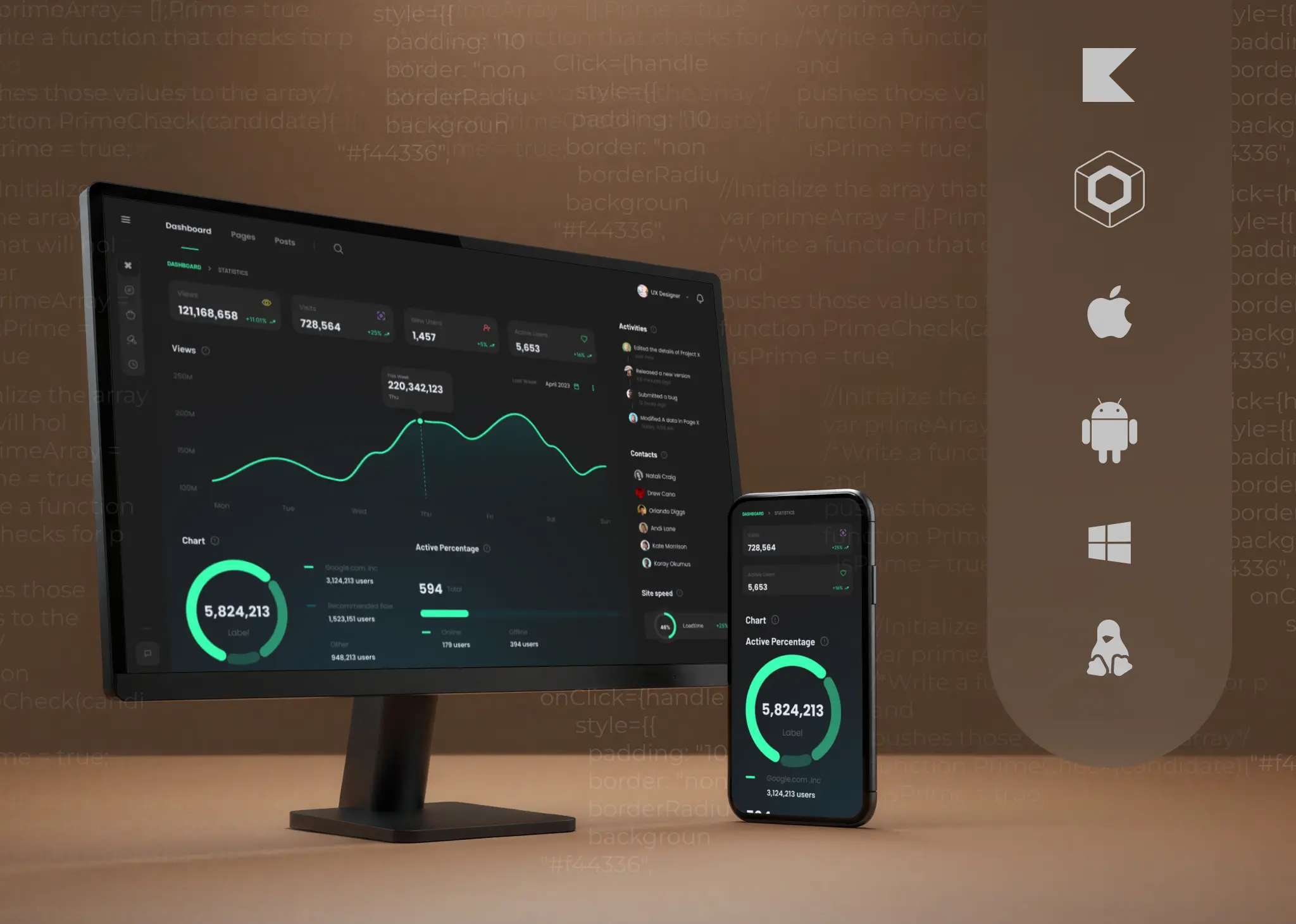
In mobile development, one such challenge is the move to multiplatform development. Maintaining Android and iOS as two separate platforms stops paying off. Entain CEE, which runs the STS betting app for the Polish market, came to us with a performance problem. The app was already live and had started to struggle in key user scenarios at peak load.
We didn't start rewriting. We ran an App Health Check across the frontend, backend and the shared Kotlin Multiplatform layer, ordered the priorities by business impact, and delivered targeted optimisation within two months. CPU load dropped by 70 to 80 percent in selected high-load scenarios and customer satisfaction reached 74 percent.
No rewrite, and no disruption to the running service. On KMP we're clear on one thing. We share business logic and keep the user interface native. Shared UI is a separate decision with its own trade-offs, and we don't do it automatically.
Large apps and super apps work the same way. You can't build them quickly. It's years of work. You add features, redesign, and build a whole ecosystem step by step. That's how DoKapsy by ČSOB grew. It's a strong example from banking of how a bank can extend its services well beyond finance.
Since 2020 we've helped build an ecosystem of roughly twenty services, now used by more than half a million people. Almost half of them aren't ČSOB clients. Whoever controls the payment often controls the whole customer relationship.
ČSOB is a good place to see how a partnership can shift over time. The DoKapsy experience opened the door to the main ČSOB Smart banking app. Since 2023 our people have gradually taken over key roles there from the previous supplier, on both iOS and Android. We've moved from one of several suppliers to the main external partner for mobile development, and today we help steer where the app is heading, well beyond handling individual tasks.
AI adoption is the newest of these challenges. Companies are testing AI or integrating it straight into their products and processes, and the pressure to respond keeps growing. Adding AI is never the goal in itself. The point is to simplify, speed up or improve the outcome, and sometimes better information architecture gets you there sooner than a language model.
For ROSSMANN we built Rossi, a virtual shopping advisor sitting over the entire product catalogue. In the first two weeks after launch the number of queries rose by 80 percent, and around half of them ended in a purchase the same day, in store and online.
We've worked on the ROSSMANN CLUB app since 2019. What began as a loyalty app grew into an e-shop, a website and finally a personalised ecosystem for 1.2 million customers. Rossi is its latest layer, not its first idea.
Insourcing and outsourcing are always being balanced
Balancing insourcing and outsourcing is a normal phase companies go through. We take it as a legitimate stage, and it doesn't threaten us. It's rarely clear at the outset what should be done internally and what shouldn't. A company usually works it out along the way, as priorities, capacity or the availability of people on the market change, and sometimes the whole vision with them.
An external partner is useful because it solves several things at once in practice. It gives access to a range of developers and technologies, so the company isn't dependent on one internal person. It's cheaper and faster than building the same capacity in-house, especially with senior people who think about a task both technically and in product terms.
It lets you plan capacity around the roadmap without filling every gap through hiring. When someone leaves the team, we handle continuity and the replacement, not the client. And none of this stops a company building its own team. We can bridge the knowledge gap and hand over know-how so the client eventually takes over the main part of the project themselves.
„ČSOB has been collaborating with Etnetera Group for over 10 years in IT, digital analytics, and app development. We appreciate that Etnetera is a long-term technological and consulting partner for us, valued for its quality, know-how, and fair approach." - Vladimír Vojtíšek, Executive Director Daily Banking, ČSOB
Leaving isn't a loss
Across projects we try to build digital products so the client can carry on without us. We use open, widely adopted technologies and architectures, because a product lasts for years on them. Our view and the client's don't always meet, and then it comes down to discussion and finding a compromise. When someone insists on a solution that doesn't make sense to us, we're able to say we won't deliver that project.
Košík.cz is a good example. For the second largest Czech online supermarket we built the mobile app from scratch, from business consulting through UX and architecture to development and testing, on a modular architecture so it could be developed further easily. Once the app was done, Košík's internal team took over maintenance. The handover went smoothly and the collaboration paused there.
"It was an honor to work with the team from Etnetera Flow. Our collaboration was a perfect blend of technical know-how in new technologies and business acumen. Their team understood what we wanted to achieve, what mattered, and what didn't. Our team appreciated their fresh perspective, flexibility, and quick delivery of new features. Neither side saw the other as an intruder, which is why we were able to create a great application in a very short time." - Jakub Růžička, Engineering Manager & Mobile Development Expert, Košík.cz
Some time later Košík got back in touch to ask whether moving to a shared Kotlin Multiplatform layer made sense. We analysed the architecture, mapped the impact on maintenance costs and proposed a concrete migration roadmap. The decision on timing is Košík's. The preparation is done.
Sometimes a collaboration deepens instead. That's what happened with Škoda Auto, where we took over the original app from the previous supplier, stabilised it and completely rewrote it into today's MyŠkoda app. Etnetera and Škoda Auto set up the Green:Code joint venture together, and development continues there.
We have no special methodology for knowledge transfer. It's more a consistent, open approach. Our people routinely work in mixed teams with the client's staff and deal with them transparently. We treat that as standard. Managers who've experienced honest dealing with us carry that experience on, even when they change employer.
The harder the project, the more this matters. And the more every company needs a partner that won't build it a pointless trap to get stuck in at the worst possible moment.
.webp)
.webp)
.webp)
.webp)
.webp)
.webp)
.webp)


.jpg)
.jpg)
.png)
.avif)

.avif)


