



Most apps are invisible by default. Development teams invest heavily in building something good, then leave the distribution largely to chance because discoverability in app stores is nobody's job.
Last year I wrote about app ratings. What drives them, and why a 4.8 is an engineering outcome that marketing can't manufacture.
This article is about what comes before the rating matters: whether users can find the app at all, and whether they install it once they do.
App Store Optimisation (ASO) is in fact SEO for apps. The same discipline: understand what people search for, then structure your listing so the algorithm and the user both find what they need. A lot of product teams have a search strategy for their website and nothing equivalent for their app.
We've run ASO audits on several European lifestyle and banking apps over the past year. The specifics differ, but a pattern repeats. Here is what it looks like.
Keyword coverage and title space utilisation
Take title space. On iOS, the App Store gives you 30 characters for the title and another 30 for the subtitle. One app we looked at used 15 of the 30 in the title. The subtitle was empty. The keyword field, invisible to users but read by Apple's algorithm, had significant unused capacity. It's a common starting point.
Most app titles were written by someone thinking about branding, not search. In listing terms, this is the equivalent of a website with no page titles and no meta tags. The app ranked for a fraction of the terms it could realistically compete for. Users searching for parking, cashback, digital wallet, or lifestyle rewards may never encounter it at all.
The fix isn't complicated, but it does require data. You need to know what people are actually searching for, how competitive those terms are, and which combinations improve ranking without making the title unreadable. It's ongoing work, not a one-off rewrite. Keywords shift and competitors adapt, the same way they do in search.
When you're not bidding on your brand name
Another app had strong brand search volume. A lot of people searched for it by name. But run that search on the App Store and a competitor's app appeared above the organic result via Apple Search Ads (ASA).
This is legal, common, and entirely preventable. ASA lets any developer bid on any keyword, including competitor brand names. If you're not protecting your own brand terms, you're paying to build demand at the top of the funnel and handing those users to someone else at the moment they're ready to install. It's the paid-search problem, moved into the App Store.
Brand keyword defence is one of the most cost-efficient things you can do in ASA. Bids are typically cheap because your own app is highly relevant for your own name, which Apple rewards with better quality scores. In this case it was sitting entirely unpicked.
Screenshots as a conversion tool
The screenshots in the App Store or Google Play can serve as a conversion tool. Most users spend a few seconds on them before deciding whether to install or move on.
The screenshots we tend to see show the product clearly enough, but they don't tell a story. No clear hierarchy of benefits, no social proof, no keyword-informed headlines. A user who didn't already know the app would struggle to understand the core proposition in three seconds.
The more important point: you don't have to guess what works. Both the App Store and Google Play support A/B testing on creative assets. You can run two versions of your screenshot set against real traffic and let the data decide. It takes a bit of setup, but it removes a lot of opinion from a decision that should be empirical.
The app onboarding problem
This is the part I find most interesting, because it's where ASO work runs directly into app reality.
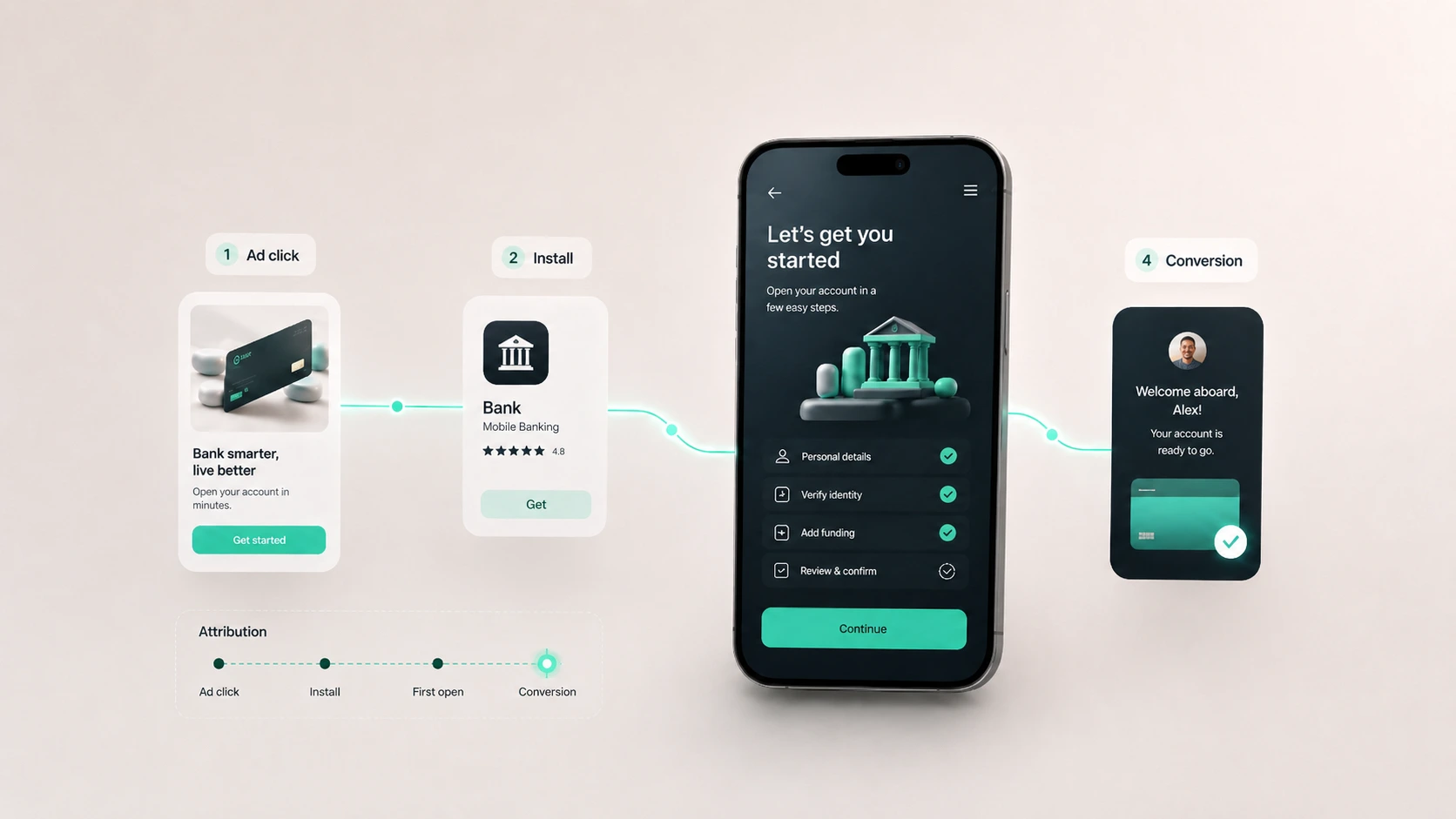
For one banking app, we looked at the first-launch experience. Before a new user reached the home screen, they went through twelve screens. Consent flows, registration, data permissions. By the time they got to the actual product, a significant portion of them had already left.
You can have the best keyword strategy in the world and run efficient paid acquisition. If the onboarding has this level of friction, you are pouring water into a leaky bucket.
Fixing this requires more than a UX redesign. Legal, compliance, and architectural decisions all play a role, specifically around when data is collected and in what order. The audit flagged it. From there it was the product and marketing teams and us, working it out.
The honest takeaway
The apps we audit are usually well-built products that are significantly underselling themselves. Nothing we find requires a major rebuild. It requires attention, the right data, and someone who owns the App Store and Google Play the way they'd own any other product surface.
Keywords shift, competitors adapt, Apple and Google change their algorithms. Apps that see consistent results treat ASO as something you measure, adjust, and improve continuously.
We've formalised a partnership with Verdianz, a Copenhagen-based agency specialising in ASO and performance marketing, to offer this as a structured service. If you want to know what your app is leaving on the table, that's exactly what the audit is designed to answer.
Get in touch if you'd like to talk it through.
.webp)
.webp)
.webp)
.webp)
.webp)
.webp)
.webp)


.jpg)
.jpg)
.png)
.avif)

.avif)


