


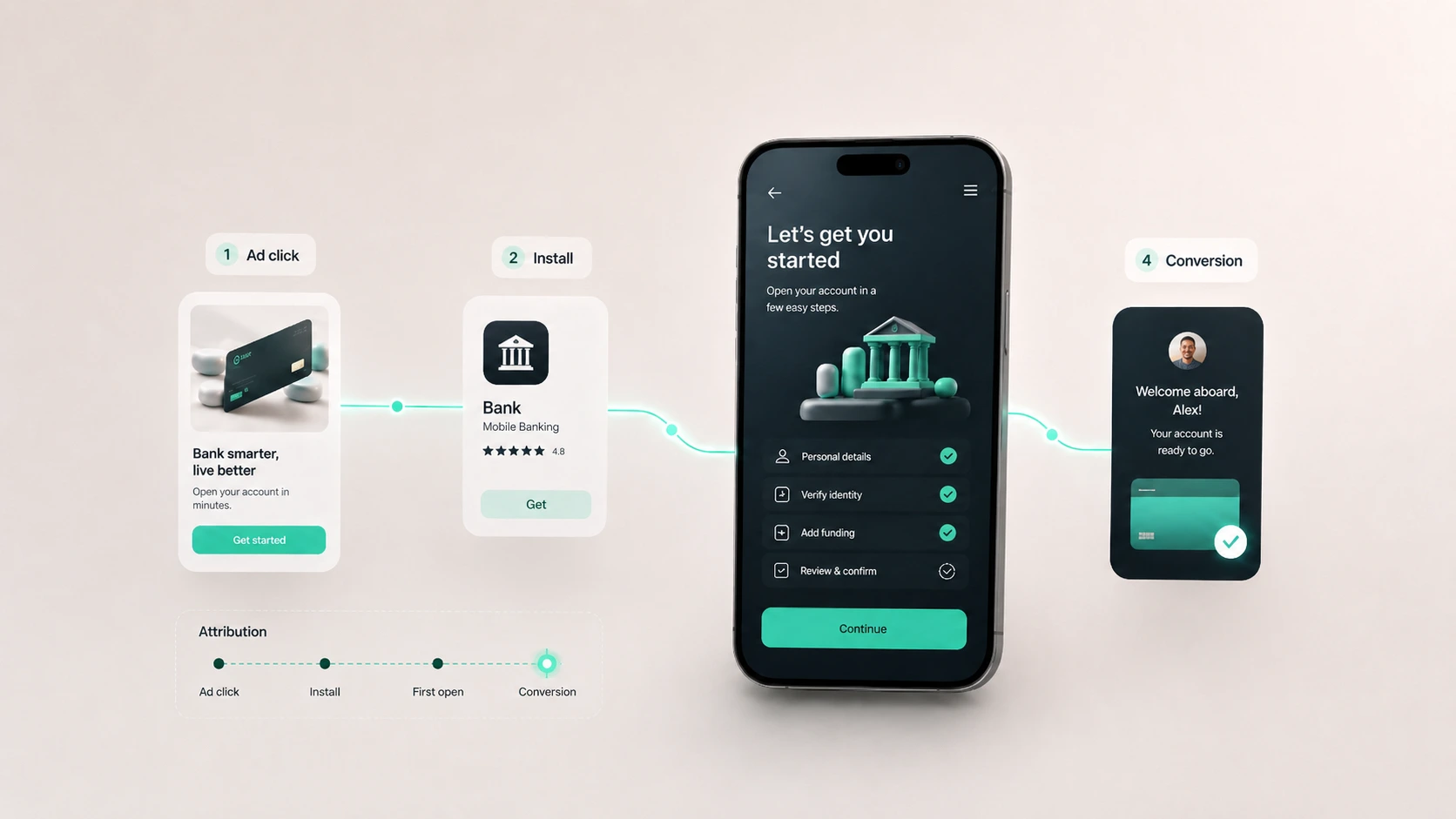

Some banks now operate entirely through their mobile app. There is no web equivalent for opening an account, no desktop fallback for onboarding. The app is the product, and everything around it, from acquisition campaigns to post-install experience, has to work with that assumption.
In the projects I have worked on, this shift is not always obvious to the marketing side. They often reach for web analytics logic and expect it to translate. It does not.
Take a typical scenario. A bank runs a campaign with a sign-up bonus for opening a new account. The user taps the ad, but the account can only be opened inside the app, which they do not have installed. So they go through the app store, install, open, and eventually complete the onboarding.
From a marketing perspective, this is where visibility typically disappears. The click happened in one environment, the install in another, the conversion in a third. Without a dedicated setup, there is no reliable way to connect them. The campaign either looks like it underperformed, or it cannot be evaluated at all.
This is where specialised tools, often called mobile measurement partners (MMPs), come in. They reconnect the journey across environments so companies can see what actually drives growth.
Where the journey breaks: click, install, conversion
The break happens at installation. The user leaves the browser, goes through the app store, and enters a different environment. The click that started the journey and the install that followed happen in systems that do not naturally share data.
On iOS, Apple's App Tracking Transparency framework limits what can be tracked across apps without explicit user consent. Android offers more signal through the Google Advertising ID, but with its own constraints.
Without a dedicated setup, marketing teams work with systematically misleading data. And most of the time, they do not know it.
MMPs close this gap through a mechanism called deferred deep linking. When a user taps an ad without the app installed, the campaign context is preserved through the store visit and install, and passed into the app on first open.
The user lands exactly where the campaign intended, and the marketing team gets a reliable connection between the click, the install, and whatever happens next.
In projects where mobile is a primary channel and marketing spend is significant, we typically implement AppsFlyer. It handles deferred deep linking reliably across iOS and Android and integrates well with the marketing and analytics tools most of our clients already use.
But the tool is a means, not the point. For smaller products or different contexts, a lighter setup often makes more sense, and I will push back when a client asks for AppsFlyer without a real reason.
When the journey itself breaks, not just the measurement
The same transition that makes attribution hard also breaks the experience. A user starts something on the web, continues in the app, and somewhere in between loses context.
In banking, insurance, or any mobile-first service, this is not an edge case. It is one of the most common friction points in the funnel, and in my experience, one of the most underestimated.
Our client ČSOB is a good example. A user begins opening a bank account on the web, fills in initial data, and at a certain point has to continue inside the mobile app. If the app is not installed, they go through the store first.
The transition is the moment where context is easiest to lose. In ČSOB's setup, it does not. The following is carried through, using deferred deep linking via AppsFlyer:
- pre-filled data from the web form
- the exact step in the onboarding
- the campaign source
- the pre-selected product variant
The user opens the app and continues from where they stopped, not from a generic home screen.
Each of those four pieces is a separate decision. What belongs in the link, what belongs in the user's session, and what belongs in the backend state. These are not purely technical choices. They shape how the product behaves when campaigns change, when the app is updated, or when a new channel is added.
The drop-off at this transition is typically higher than anywhere else in the funnel. Which means the setup behind it, deep linking, deferred deep linking, state continuity, is not a technical detail. I have seen teams treat it as plumbing and pay for it later.
"Integrating the AppsFlyer solution helped us measure the entire customer journey, along with the effectiveness of our various advertising channels and product landing pages. It also helped us tailor onboarding to different customer segments and made assisted selling more comfortable for our bankers." — Cyril Křůpala, ČSOB
When attribution becomes a product decision
For many companies, the app is where the most important parts of the customer journey happen. Users log in, transact, manage accounts, and return regularly.
This is particularly true in banking, insurance, e-commerce and other mobile-first services, where some providers operate primarily or entirely through the app. It is also why companies increasingly build app-driven digital ecosystems around their core product.
When the app plays this role, gaps in attribution or broken journeys cost more. Marketing budgets get bigger, onboarding flows get more complex, and the cost of a user who drops off or cannot be traced grows with them.
At the same time, this is not a universal need:
- for smaller products or single-market environments, a well-built mobile web often covers the core use cases
- for apps where acquisition is driven mostly by organic or retention, a full MMP setup can be hard to justify
In those cases, we often recommend or implement simpler alternatives. The right setup is the one that matches the decisions the business actually needs to make, not the one with the longest feature list.
The need for a dedicated attribution layer typically emerges at a specific point:
- when mobile becomes a primary channel
- when marketing investment starts to scale
- when decisions about budget, channel performance, or product direction start depending on signals that the current setup cannot reliably provide
The real test is whether your current setup gives you the confidence to make decisions about growth, budget, and direction. If the answer to any of those is unclear, the setup is probably the issue.
If that sounds familiar and you want to talk it through, I'm happy to have that conversation.




.webp)


.webp)
.webp)



.webp)

.webp)


.webp)

.webp)


.jpg)
.jpg)
.png)
.avif)

.avif)


